
Blogs
Is On-Premises Really Safer Than the Cloud? It’s Time to Challenge the Assumption.
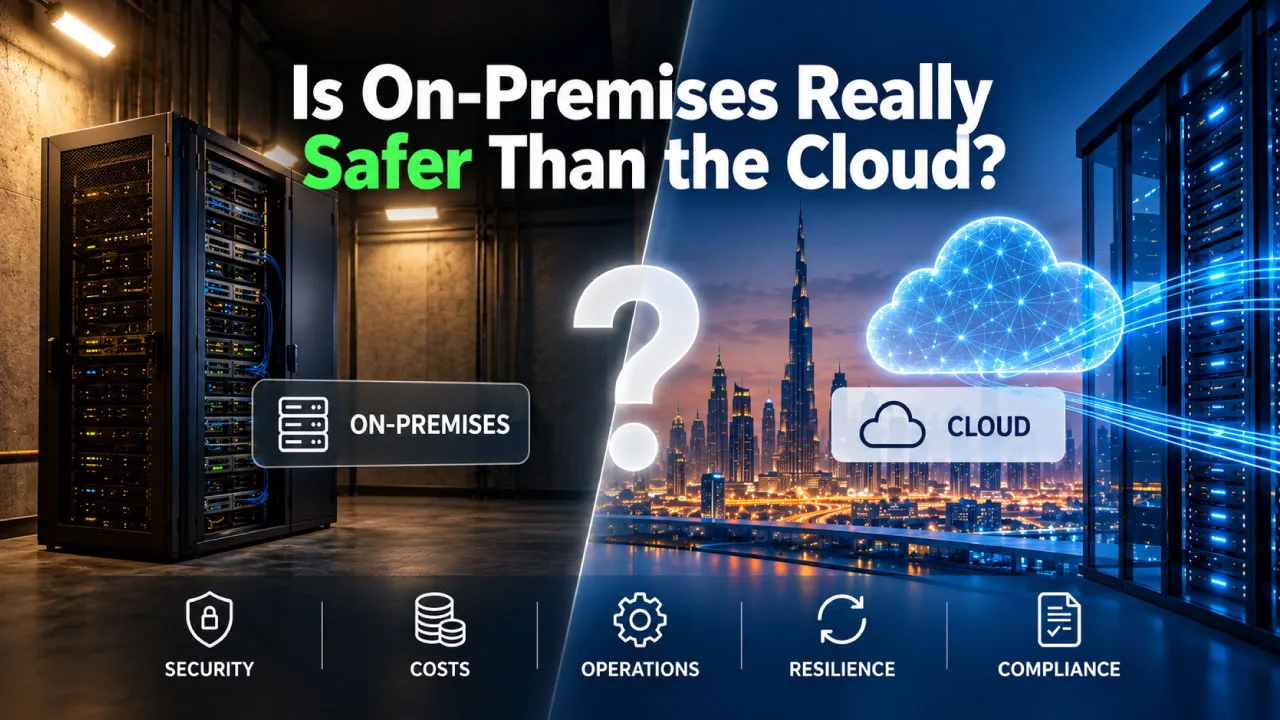
As organisations place greater emphasis on cybersecurity, data sovereignty and operational resilience, is moving technology on-premises always the right answer?
Across the Middle East, we are seeing increasing interest in on-premises technology deployments, particularly among organisations managing sensitive information, essential services and critical infrastructure.
The reasoning is understandable. Organisations want greater control over their systems, stronger data protection and confidence that their technology will remain operational when disruptions occur.
But there is an important question that deserves more attention:
Does moving technology on-premises genuinely make an organisation more secure and resilient, or can it introduce additional risks, costs and operational challenges?
At VERTECO, where we work with connected technologies, IoT infrastructure and intelligent building management solutions, this is an increasingly relevant discussion.
And it is one I believe the industry should be having.
Does Physical Control Mean Greater Security?
There is a common perception that keeping servers within an organisation’s own facilities provides greater protection.
After all, the infrastructure is physically controlled, data remains within the organisation’s environment, and external connectivity can be restricted.
These can be legitimate advantages, particularly where specific regulatory, security or operational requirements apply.
However, physical ownership and security are not necessarily the same thing.
An on-premises deployment places significant responsibility for cybersecurity, infrastructure resilience, patching, monitoring, backups and disaster recovery directly on the organisation and its appointed service providers.
Major cloud providers operate sophisticated infrastructure supported by dedicated security teams, extensive monitoring capabilities, redundancy and specialist expertise.
Can every organisation realistically replicate those capabilities internally?
And does concentrating critical technology within a single physical location always deliver the resilience an organisation requires?
A server located inside your own facility is not automatically more secure or resilient than one hosted in a professionally managed data centre.
Ultimately, the security of either environment depends on how it is designed, configured, maintained and governed.
The Costs That Are Often Overlooked
One of the biggest misconceptions surrounding on-premises deployment is that purchasing servers eliminates the ongoing costs associated with cloud hosting.
In reality, the server purchase is often just the beginning.
A properly managed on-premises environment may require:
- Server hardware, storage, networking and associated infrastructure
- Virtualisation, operating system and other software licences
- Firewalls, endpoint protection and security monitoring
- Backup infrastructure and disaster recovery arrangements
- Redundant power supplies, UPS systems and cooling
- Specialist IT personnel for maintenance, monitoring and troubleshooting
- Regular security updates, patching and vulnerability management
- Hardware replacement, lifecycle management and capacity expansion
- Vendor access arrangements, support agreements and ongoing system upgrades
For smaller or specialist technology deployments, particularly IoT applications, these requirements can become disproportionately expensive.
A relatively straightforward cloud-hosted application can become a much larger infrastructure project once deployed within a client’s own environment.
And the financial implications are not limited to the initial installation.
The real comparison should be the total cost of ownership over five to seven years, not simply the cost of a server versus a cloud subscription.
To be fair, cloud costs also require careful management. Poorly optimised workloads, excessive data transfer, subscription charges and long-term resource consumption can make cloud hosting expensive.
But those costs should be compared against the complete on-premises operating model, not just the initial hardware investment.
Resilience: What Happens When Something Goes Wrong?
This is perhaps the most important question of all.
Regardless of the hosting model, organisations need confidence that their systems can withstand disruptions and recover quickly when problems occur.
Consider an on-premises deployment operating from a single facility.
What happens if that building loses power?
What happens if cooling fails, network connectivity is interrupted or physical access becomes restricted?
What happens if the server suffers a critical hardware failure?
And perhaps most importantly, how quickly can the system be restored?
On-premises infrastructure can absolutely be designed with redundancy and disaster recovery capabilities. But achieving meaningful resilience generally requires additional infrastructure, independent failure domains, tested recovery procedures and ongoing investment.
A well-architected cloud environment can provide geographic separation, automated recovery and infrastructure redundancy without each individual organisation having to build those capabilities from scratch.
Of course, cloud infrastructure is not immune to outages, cyberattacks or regional disruption either. Its resilience depends on the architecture selected, including the availability of independent locations and properly configured recovery arrangements.
The important distinction is not where the servers are located, but how effectively the entire system has been designed to withstand failure.
The Operational Challenges Are Often Underestimated
There is another consideration, particularly relevant to smart buildings, facilities management and IoT deployments.
Modern connected solutions are not simply installed and forgotten.
They require ongoing software updates, device management, security patches, integrations, analytics, reporting and technical support.
In a cloud environment, many of these activities can be managed centrally, subject to appropriate security controls.
In a highly restricted on-premises environment, particularly where remote access is prohibited, even relatively routine activities can become complicated.
A software update may require a scheduled site visit.
Troubleshooting may depend on the availability of the client’s IT personnel.
Integration changes may require multiple approvals.
An urgent security patch may be delayed by access restrictions or change-control procedures.
None of these challenges is insurmountable, and appropriate security controls must always take priority. However, they introduce additional costs, dependencies and potential delays that should be understood from the outset.
For connected building technologies, the ability to maintain, update and support the platform throughout its operational life is just as important as the initial deployment.
A system that is difficult to maintain can become an operational risk, regardless of where it is hosted.
Data Sovereignty Does Not Automatically Mean On-Premises
Data sovereignty is an entirely legitimate consideration, particularly for public sector organisations and regulated industries.
However, data residency, data sovereignty and physical server ownership are not interchangeable concepts.
The UAE has made significant investments in digital infrastructure, cloud security frameworks and sovereign cloud capabilities, supporting secure digital transformation across public and private sectors.
Depending on applicable regulations, information classification and security requirements, appropriately configured in-country or sovereign cloud environments may offer an alternative to maintaining dedicated infrastructure within each organisation.
The question should therefore be whether the proposed hosting environment satisfies the relevant security, sovereignty and regulatory requirements — not simply whether the server is physically located within the client’s own building.
Perhaps Hybrid Is the More Sensible Conversation
This should not become an argument about cloud versus on-premises.
There are legitimate reasons for choosing on-premises deployment, including classified environments, operational technology, low-latency requirements, disconnected networks and specific regulatory obligations.
Equally, cloud hosting is not automatically the right answer for every application.
In many situations, hybrid architectures may offer an effective balance.
For example, in smart washroom and intelligent building applications, local devices and gateways can be designed to continue collecting information and performing essential functions during a connectivity interruption.
Cloud infrastructure can then provide centralised analytics, historical reporting, remote management and wider operational visibility.
This approach can preserve essential local functionality while benefiting from the flexibility and scalability of cloud-based services.
The appropriate architecture should follow the operational and security requirements.
Not the other way around.
Security Should Be Based on Evidence, Not Assumptions
As organisations continue strengthening their cybersecurity and business continuity strategies, hosting decisions deserve careful consideration.
Moving infrastructure on-premises may increase direct control, but it also increases responsibility.
It may address specific data governance requirements while introducing additional infrastructure and operational dependencies.
It may reduce reliance on external connectivity while increasing dependence on local facilities, equipment and support resources.
Before selecting any hosting architecture, organisations should be asking:
What specific risks are we trying to address, and can we demonstrate that the proposed architecture delivers the security, resilience and operational outcomes we require?
A comprehensive assessment should consider cybersecurity, physical resilience, regulatory compliance, disaster recovery, operational support and total cost of ownership.
Because ultimately, resilience is not about owning the server.
It is about ensuring the service continues to operate securely, reliably and effectively when something goes wrong.
Perhaps it is time we stopped asking, “Cloud or on-premises?” and started asking, “Which architecture genuinely makes us more resilient?”
Latest Posts
World’s Best Airport Washrooms 2026: How Smart Technology Is Changing Passenger Experience
From basic facility to passenger experience: how smart washrooms and data-driven facilities management are transforming airport operations.
How Restroom Occupancy Sensors Help Reduce Queues in High-Footfall Event Washrooms
When lots of people arrive at a venue within a short space of time, it puts pressure on all facilities, especially washrooms.
From Cleanliness to Comfort: How Smart Washroom Technology Improves Mosque Worshipper Experience
Cleanliness is an essential part of the mosque experience. Prayer-time washroom use places high demand on these spaces, especially during peak periods.
Smart Washroom Solutions in Retail: Improving Customer Experience, Dwell Times and Operational Performance
Retail environments must deliver an exceptional customer experience whilst maintaining operational efficiencies.
Earth Day Insights: Reducing Resource Waste Through Smart Washroom Innovation
World Earth Day serves as an annual reminder that sustainability is no longer a future ambition, but a critical operational responsibility.