
Blogs
Occupancy Sensors, Making Social Distancing Simple
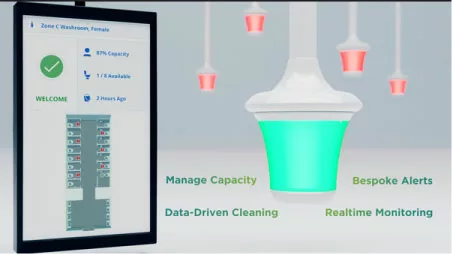
Keeping a safe distance from others has become the norm. The use of occupancy sensor technology allows businesses to do it effectively and efficiently.
A New Concept of Social Distance
The concept of social distancing was introduced to us all in March 2020. We were told by authorities that it was the simplest and most effective way of preventing the spread of COVID-19.
Over the coming months and years, we all learnt to adapt. Maintaining a safe distance from others very quickly became the norm.
And as public spaces became less crowded and more spacious environments, we very quickly realised that social distancing was not only a necessity, but actually a preference.
From offices and classrooms to shopping malls and washrooms, reduced capacities made for a much more comfortable and pleasant experience.
No Going Back on Improved Experiences
Spaces were not only less crowded, but they were more hygienic and easier to manage from an FM perspective. This prompted many businesses that hadn’t already done so to consider installing occupancy sensors to not only offer their customers a socially distanced space, but to benefit from the range of other operational advantages that came with it.
How do Occupancy Sensors Support Social Distancing?
Occupancy sensors are essentially the use of technology to measure people numbers accurately. They are a component of smart buildings which use IoT sensors to accurately track people movement, in real-time.
Information is gathered on where people are within any given space, and smart systems can then adjust a wide range of variables accordingly. These changes are designed to ensure occupancy levels are never exceeded, but they also offer many operational, waste and cost savings at the same time.
Apart from the numerous benefits to the consumer, many occupancy management systems are easy-to-fit, retro fit additions, offering businesses a cost-effective solution to managing occupancy.
Occupancy vs. Vacancy Sensors
The two shouldn’t be confused. Occupancy sensors are used to detect the movement of people to ensure the most energy and cost efficient, and improved environment for the inhabitant of the space. They differ from vacancy sensors as they respond to motion alone.
Vacancy sensors need to be turned on manually by the user and are therefore not as suitable for large public spaces.
Commercial and Retail Occupancy Sensors
Social distancing aside, occupancy sensors can be used in commercial and retail spaces to control many variables. Let’s take AC and lighting control within an office space as an example. If an occupancy sensor detects that no one is using a certain meeting room during the day, the AC can be lowered, and the lights turned off to save money and energy. When the room is occupied, the AC is immediately altered and the lighting switched on – and even adjusted according to the time of day and availability natural light, supporting maximum occupant comfort.
Occupancy in the Washroom
Nowhere is distancing yourself from others more desirable than in the washroom.
In busy malls or airports, visitor numbers can, at certain times, be extremely high. Footfall can also be hard to predict, with crowds very quickly forming in small spaces.
But with the use of occupancy sensors in a washroom, FM teams can accurately track the movement of individuals and monitor their numbers within individual restrooms. With such a wealth of real time information, management teams can then make the most effective and efficient operational decisions – ensuring the best possible customer experience at the same time.
Social Distancing and Cleanliness Advantages
By monitoring the number of people in a certain washroom, occupancy sensors can quickly alert the public to overcrowding and divert them to quieter, more socially distanced facilities nearby.
Improved social distancing also supports cleaner spaces. Without overcrowding, there simply isn’t the mess. But the sensors go beyond preventing overuse by keeping numbers down. With information on surges in numbers, FM teams can adjust cleaning schedules to reflect actual usage and offer the best possible approach to keeping places sanitary.
Cost and Energy Savings
Businesses can also benefit from significant monetary and environmental savings when occupancy is managed.
With up-to-the-minute, accurate data on people numbers, facilities teams can develop the most efficient cleaning schedules possible, with teams diverted to where they are actually needed. This also reduces environmental waste from the overuse of cleaning chemicals and supplies.
Beyond the Washroom
This smart, informed, and proactive approach to maintaining social distancing can be applied beyond the washroom.
The so-called ‘data driven cleaning’ approach can be applied to an entire building or facility. Using integrated operational and environmental IoT sensors, data can be collected on many different variables.
With a wealth of data, and integrated smart cleaning technology, FM teams can respond to actual occupancy requirements and provide the most comfortable, socially distanced environments possible – in the washroom and beyond.
Latest Posts
Elevating Hospital Hygiene and Safety Standards with Data-Driven Cleaning
Within hospitals, patient safety and infection control are non-negotiable.
World Earth Day: Advancing Water Sustainability with Smart Washroom Sensors
April 22 marks Earth Day, a global event dedicated to environmental protection and sustainability.
Why the Smart Washroom market is set for explosive growth in 2025
Smart washroom technologies have revolutionized the public restroom experience.
Revolutionising the passenger experience: How smart washroom technology transforms airport operations
From real-time hygiene monitoring to water conservation, IoT-driven washroomsare transforming passenger experiences and operational efficiency
Smart Washrooms in Airports
Modern airports are busy spaces. With millions of passengers transiting daily, efficiency and cleanliness are more than conveniences – they are necessities.